Team Building Games
The best team building games for work teams, corporate events, and group bonding. From quick icebreakers to full-day activities, these games build trust and improve communication.
✍️ March 25, 2025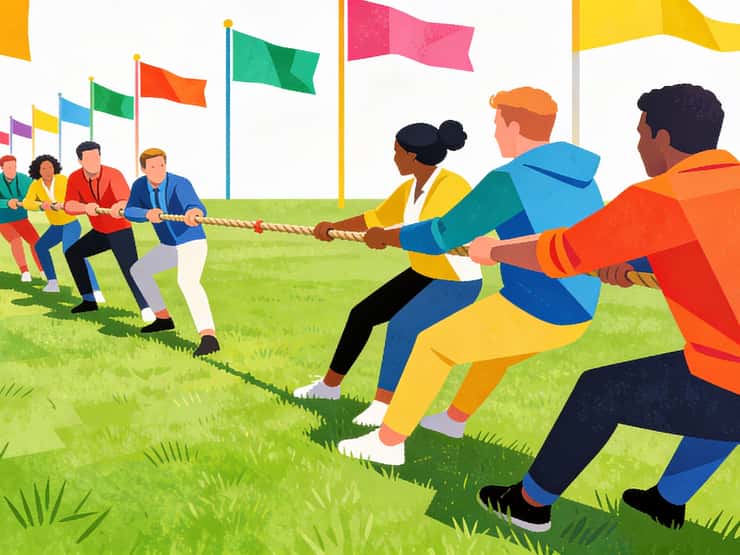
- 🏢 Why Team Building Games Matter
- 🧊 Quick Icebreakers (5-10 Minutes)
- 🧩 Problem-Solving Games (20-45 Minutes)
- 🏃 Active Team Games (15-30 Minutes)
- 💻 Virtual Team Building Games
- 🎯 Competitive Team Games
- 🧠 Creative Team Challenges
- 🌳 Outdoor Team Activities
- 📋 How to Choose the Right Game
- ⚡ Making It Work
Most people hear “team building games” and immediately picture forced fun in a conference room - trust falls, awkward sharing circles, and activities that make everyone wish they were back at their desks. It doesn’t have to be that way. The best team building games feel like actual games, not corporate exercises with a thin veneer of fun painted over them.
Good team building creates genuine moments of collaboration, laughter, and problem-solving. When your quiet developer suddenly takes charge during a trivia round, or the new hire turns out to be a surprisingly effective charades player, those moments shift how people see each other. And that shift carries over into real work.
This guide covers games that people actually enjoy playing, from five-minute icebreakers to full afternoon activities.
Why Team Building Games Matter
Teams that play together communicate better. That’s not corporate motivation-speak - it’s just how human relationships work. Shared positive experiences create trust, and trust makes collaboration easier.
But the game matters. Pick something that feels forced and you’ll create resentment, not bonding. Pick something genuinely engaging and people forget they’re at a “team building event” and just start having fun. That’s the goal.
The key principles for choosing games:
- Participation should feel natural, not mandatory. Give people opt-out options without making it awkward.
- Competition is good, embarrassment is not. Games should challenge people without putting anyone on the spot.
- Mix physical and mental activities. Not everyone is athletic, and not everyone is a trivia buff. Variety lets different people shine.
- Keep it time-appropriate. A 10-minute icebreaker energizes. A 3-hour mandatory game session drains.
Quick Icebreakers (5-10 Minutes)
Use these at the start of meetings, retreats, or any gathering where people need to warm up.
Two Truths and a Lie
Two Truths and a Lie is the easiest icebreaker that actually works. Each person shares three statements about themselves - two true and one false. Everyone else guesses the lie.
This game works because it lets people share interesting things about themselves in a low-pressure format. The person controls what they reveal, so nobody feels exposed. And learning that your manager once competed in a hot dog eating contest changes the dynamic in the best way.
For teams: Go around the room, giving each person 2-3 minutes. With 10 people, the game takes about 20 minutes. For larger groups, break into smaller circles of 5-6 people.
Quick-Fire Would You Rather
Would You Rather gets people talking and debating within seconds. Pose a dilemma and have people physically move to different sides of the room based on their answer.
Work-appropriate examples:
- Would you rather have an extra week of vacation or a $2,000 bonus?
- Would you rather never attend another meeting or never write another email?
- Would you rather work from home forever or have the best office in the building?
- Would you rather have a 4-day work week or finish at 2 PM every day?
The physical movement energizes the room, and the debates that follow reveal personalities. Keep it light and work-adjacent - nothing too personal for a professional setting.
Name Tag Switch
Each person writes three little-known facts about themselves on a name tag. Tags get shuffled and redistributed. Everyone has to find the person whose tag they’re wearing by mingling and asking questions. First person to correctly identify their match wins.
This forces genuine conversation and works especially well for teams where new members are joining established groups.
Problem-Solving Games (20-45 Minutes)
These games require teams to communicate, strategize, and collaborate - the exact skills that transfer to real work.
Marshmallow Tower Challenge
Give each team 20 sticks of spaghetti, one yard of tape, one yard of string, and one marshmallow. They have 18 minutes to build the tallest freestanding structure that supports the marshmallow on top.
This challenge is famous in business schools for a reason: it reveals how teams approach problems. Some teams plan extensively and run out of time. Others build immediately without thinking. The best teams prototype quickly, test early, and iterate. Sound familiar?
Debrief tip: After the challenge, ask each team what strategy they used and what they’d change. The parallels to project management write themselves.
Escape Room (In-Office Version)
Create a simple escape room in a conference room. Hide clues around the room, create a series of puzzles that lead to a final code, and set a 30-minute timer. Teams of 4-6 work together to solve it.
Puzzles don’t need to be complex:
- A coded message using a cipher alphabet
- A combination lock with the code hidden in a riddle
- A jigsaw puzzle that reveals a clue when completed
- A UV light revealing hidden text
You can also purchase ready-made escape room kits online for $15-30 if you don’t want to build your own.
Desert Island Survival
The scenario: Your team’s plane crashed on a deserted island. You can only save 10 items from a list of 25. The team has 15 minutes to agree on which items to keep.
The list includes things like: a knife, rope, tarp, matches, mirror, first aid kit, compass, water purification tablets, fishing line, flare gun, canned food, sunscreen, map, radio (no batteries), blanket, ax, bucket, whistle, chocolate bars, binoculars, duct tape, magnifying glass, insect repellent, salt, notebook and pen.
The real exercise isn’t the list - it’s watching how teams make decisions. Who leads? Who listens? Who advocates for their choice? Who compromises? The dynamics that emerge mirror real workplace decision-making.
Bridge Building
Two sub-teams each build half of a bridge using craft materials, but they can’t see what the other team is building. They can only communicate verbally through a designated messenger. When the timer runs out, the halves must connect.
This game directly mirrors situations where distributed teams need to coordinate without seeing each other’s work. The frustration and eventual success (or spectacular failure) creates strong shared memories.
Active Team Games (15-30 Minutes)
Physical games work best outdoors or in large spaces. They get people out of chairs and into a different mode.
Human Knot
Everyone stands in a circle, reaches across, and grabs hands with two different people. Without letting go, the group has to untangle into a circle. It requires communication, patience, and spatial thinking.
Keep groups to 8-10 people. Larger groups take too long and people on the outer edges disengage. Run multiple knots simultaneously for bigger teams.
Charades Tournament
Charades works brilliantly as a team building game because it requires vulnerability (acting silly in front of colleagues) and teamwork (reading your teammate’s terrible acting). Use work-related prompts mixed with pop culture for the best results.
Work-themed charades prompts: “video call with a bad connection,” “pretending to look busy,” “the printer is jammed again,” “that meeting that could have been an email.”
Split into teams of 5-6. Each player gets 60 seconds to act out as many prompts as possible. Three rounds per team. The prompts about workplace situations always get the biggest laughs because everyone recognizes them.
Scavenger Hunt
Create a list of items or challenges that teams must complete around the office, building, or neighborhood. Include a mix of physical tasks (take a photo with a specific landmark), knowledge tasks (find out what year the building was constructed), and creative tasks (write a team jingle in 2 minutes).
Set a 45-60 minute time limit and have teams work in groups of 4-6. Use phones to document completed challenges. The team that completes the most tasks wins.
Virtual Team Building Games
Remote teams need connection too, and screen fatigue is real. These games work over video calls without making people want to close their laptops.
Virtual Trivia
Run a trivia game over Zoom or Teams. Share questions on screen, teams discuss in breakout rooms, then come back to submit answers. Use a shared scoreboard everyone can see.
Virtual trivia works because it’s familiar, competitive, and doesn’t require anyone to do anything embarrassing on camera. Mix general knowledge with company-specific questions (“What year was the company founded?” or “How many steps are in the office stairwell?”).
Remote Who Am I
Based on the classic Who Am I game. Each player is privately assigned a famous person via direct message. During the call, they can only ask yes-or-no questions to figure out who they are. Other players answer their questions.
Virtual Show and Tell
Each person has 2 minutes to show something in their home or workspace that tells a story about who they are. It could be a souvenir, a pet, a hobby project, a book, or anything meaningful. This is simple, personal, and creates genuine connections.
Online Escape Rooms
Several platforms offer virtual escape room experiences designed for remote teams. They typically cost $15-25 per person and run 60-90 minutes. Teams collaborate to solve puzzles through a shared screen interface.
Competitive Team Games
Healthy competition brings energy. These games create winners and losers, but the fun is in the playing, not the result.
Office Olympics
Set up 5-6 “events” around the office and run them tournament-style. Events might include:
- Paper airplane distance: Each team member builds and throws one airplane. Best combined distance wins.
- Desk chair relay: Push a teammate in an office chair around a course. Fastest time wins.
- Rubber band archery: Shoot rubber bands at a target from 10 feet. Best accuracy wins.
- Speed stacking: Stack and unstack cups in a pyramid. Fastest time wins.
- Trash can basketball: Shoot crumpled paper balls into a trash can from increasing distances.
Award medals or certificates for each event. The team with the most total points wins the “gold.”
Trivia League
For ongoing team building, start a weekly or monthly trivia competition. Teams stay consistent across weeks and accumulate points over a season. This creates sustained engagement rather than a one-off event.
Keep it short - 10 questions during a lunch break or at the end of a Friday meeting. A season of 8-10 rounds with a playoff round at the end gives teams something to look forward to.
Team Cook-Off
If you have access to a kitchen, split teams and give them a challenge: best dish using the same set of ingredients, best dessert under $10, or most creative sandwich. Anonymous judging by the group keeps it fair.
Even without a kitchen, “best assembled snack plate” or “best desk lunch” works in an office setting.
Creative Team Challenges
These activities exercise different muscles than typical work tasks and let unexpected talents emerge.
Pitch Competition
Give each team 20 minutes to develop and pitch a fictional product. It could be ridiculous (an app that translates your cat’s meows) or semi-realistic (a new feature for your actual product). Judge on creativity, presentation quality, and teamwork.
This exercise reveals natural presenters, creative thinkers, and people who excel at organizing ideas under pressure.
Team Mural
Provide a large paper roll and markers. Each team has 15 minutes to create a mural representing their team’s identity, values, or goals. No artistic skill required - stick figures and abstract shapes are encouraged.
The presentation of each mural is often funnier than the mural itself. “This blob represents our commitment to innovation” never fails to get a laugh.
Minute Videos
Each team creates a one-minute video about a given topic using only their phones. Topics can be workplace-related (“A day in the life of our team”) or completely random (“A movie trailer for a film about office supplies”). Screen them for the whole group and vote on a winner.
Outdoor Team Activities
Getting outside changes the energy completely. If weather and location allow, outdoor activities create a break from the work environment that indoor games can’t match.
Field Day
Organize classic field day events: relay races, tug of war, sack races, three-legged races. These activities are silly, physical, and create the kind of shared absurdity that bonds people. The VP hopping in a potato sack is an equalizer no conference room game can replicate.
Volunteer Project
Team building through community service. Habitat for Humanity builds, park cleanups, or food bank sorting give teams a shared purpose beyond the company. The sense of accomplishment is real, and working toward a tangible goal together creates genuine teamwork.
Outdoor Scavenger Hunt
Expand the scavenger hunt concept to a park or neighborhood. Use photo challenges, GPS waypoints, and physical tasks spread across a larger area. Teams navigate together and need to coordinate to cover the most ground efficiently.
How to Choose the Right Game
Not every game works for every team. Consider these factors:
Team Familiarity
- New team or many new members: Start with icebreakers like Two Truths and a Lie. Avoid anything that requires physical contact or deep personal sharing.
- Established team: Jump to competitive or problem-solving games. These teams don’t need warming up - they need fresh challenges.
- Mixed (some new, some veteran): Use games that naturally pair experienced people with newcomers. Trivia teams and scavenger hunt groups should be deliberately mixed.
Physical Considerations
- Accessibility matters. Not everyone can participate in physical activities. Always have alternative roles - timekeeper, scorekeeper, strategist - for people who can’t or don’t want to be physically active.
- Energy levels. After lunch, choose active games. First thing in the morning, go with seated activities. Late afternoon, keep it short and high-energy.
Group Size
- 5-10 people: Almost any game works at this size. Favor activities where everyone participates directly.
- 10-25 people: Split into sub-teams of 4-6. Run competitive formats.
- 25+ people: Choose games that scale: trivia, scavenger hunts, field day events. Avoid games where most people are spectating.
Making It Work
The difference between team building that people appreciate and team building that people dread comes down to a few details.
Respect people’s time. If you said the activity ends at 3 PM, end it at 3 PM. Nothing sours team building faster than running over schedule.
Make participation genuinely optional. Some people have social anxiety, physical limitations, or simply don’t want to play. That’s fine. Give them a role (scorekeeper, photographer, judge) or let them observe without making it weird.
Don’t overdo it. Monthly team building is plenty. Weekly forced fun becomes a chore. Quarterly might be even better - enough to maintain connections without feeling like an obligation.
Follow up. Reference the games afterward. “Remember when Sarah’s bridge collapsed?” or “Who knew Alex was a trivia genius?” keeps the positive feelings alive.
Keep the stakes low. Prizes should be fun, not valuable enough to create real tension. A silly trophy, first pick of meeting rooms, or the right to choose the next team lunch are perfect.
For more game ideas that work for groups of all kinds, check out our collections of trivia questions, charades prompts, and Would You Rather questions - all easily adaptable for workplace settings.
Frequently Asked Questions
What are the best team building games for small groups?
For small groups of 5-10 people, try Two Truths and a Lie, team trivia, escape room challenges, or collaborative problem-solving games like Marshmallow Tower. These games work well in conference rooms and don't need much equipment.
What team building games work for remote teams?
Virtual team building games include online trivia, virtual Would You Rather, remote charades over video call, online escape rooms, and collaborative challenges like virtual scavenger hunts. Most classic party games adapt well to video calls.
How long should team building activities last?
Quick icebreakers take 5-10 minutes. Main team building activities work best at 20-45 minutes. A full team building session with multiple games should last 1.5-2 hours. Anything longer risks losing people's attention.
What team building games don't feel forced or awkward?
Games that feel natural include trivia competitions, scavenger hunts, cooking challenges, and casual game tournaments. Avoid games that require too much physical contact or personal sharing with people you barely know.
Do team building games actually improve teamwork?
Yes, when done well. Games that require communication, problem-solving, and collaboration build real skills. The key is choosing activities that match your team's comfort level and following up with reflection on what worked.