How to Host a Trivia Night
Everything you need to host a trivia night from scratch. Step-by-step guide covering question writing, team sizes, scoring systems, themes, and hosting tips that actually work.
✍️ March 25, 2025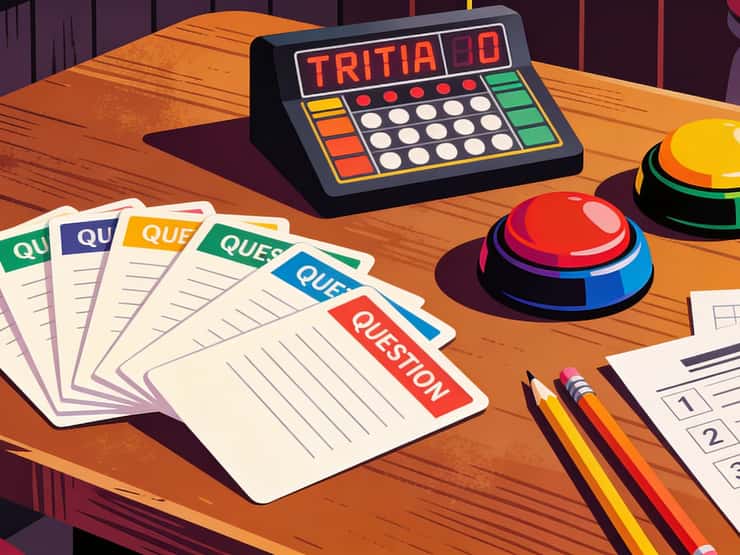
- 📋 Why Host a Trivia Night?
- 🗓️ Step 1: Planning the Basics
- ✍️ Step 2: Writing Great Questions
- 🏗️ Step 3: Structuring Your Rounds
- 📊 Step 4: Scoring Systems That Work
- 🎤 Step 5: Hosting and Presenting
- 🎨 Step 6: Choosing Themes
- 🏆 Step 7: Prizes and Incentives
- ⚠️ Common Mistakes to Avoid
- 🧰 Equipment Checklist
- 💡 Advanced Tips
Hosting a trivia night sounds simple until you actually sit down to plan one. How many questions do you need? How hard should they be? What happens when teams argue about an answer? These details separate a forgettable evening from one people rave about and ask you to do again.
The good news is that trivia nights are genuinely not that complicated once you know the formula. Whether you’re organizing one for a bar, a fundraiser, a house party, or a corporate team event, this guide walks through every decision you’ll need to make.
We’ve also got a massive library of ready-made trivia questions if you want to skip the question-writing part entirely.
Why Host a Trivia Night?
Trivia nights work in almost any setting because they tap into something universal: people love showing off what they know. The accountant who barely talks at work suddenly becomes the hero when a geography question stumps the whole room. The person who watches too many movies finally gets rewarded for it.
Unlike most party games, trivia creates natural team dynamics. People contribute in their areas of strength and lean on teammates for everything else. A good team needs the sports fanatic, the history buff, the pop culture expert, and the person who somehow knows every world capital.
Trivia also scales perfectly. It works for 8 people at a kitchen table or 200 people in a pub. The core format stays the same regardless of group size.
Step 1: Planning the Basics
Before writing a single question, nail down the logistics. These decisions shape everything else.
Venue and Setup
For a house party, you need a room where everyone can hear the host clearly. A living room or dining room works fine. For a bar or event space, you’ll want a microphone and ideally a projector or large TV.
Arrange seating so teams sit together but can’t overhear each other easily. Round tables are ideal. Long communal tables work but make cheating easier (not that anyone would).
Group Size and Teams
Teams of 4-6 are the sweet spot. This gives enough knowledge diversity without anyone feeling like a passenger. If you have 20 people, you’ll want 4-5 teams. For 40 people, aim for 7-8 teams.
Let people form their own teams, but have a plan for stragglers. “Free agent” individuals can be assigned to smaller teams or combined into a new one. Nobody should play alone unless they specifically want to.
Time Planning
A full trivia night with 5 rounds runs about 2-2.5 hours. Here’s a rough timeline:
- Welcome and rules: 5-10 minutes
- Each round: 15-20 minutes (questions + answers + scoring)
- Break between rounds 2 and 3: 10-15 minutes (food, drinks, bathroom)
- Final round and results: 20 minutes
- Prize ceremony: 5 minutes
Build in buffer time. Rounds always take longer than you expect because of answer debates, scoring questions, and general chaos.
Step 2: Writing Great Questions
Question quality makes or breaks a trivia night. Write them badly and people either breeze through bored or sit in frustrated silence. Write them well and every question creates a moment.
The Difficulty Curve
Aim for this difficulty distribution within each round:
- 3-4 easy questions that 70-80% of teams will get right. These build confidence and keep weaker teams engaged.
- 3-4 medium questions that 40-50% of teams will get right. These separate the contenders from the pretenders.
- 2-3 hard questions that only 10-20% of teams will get right. These decide who wins and create “how did you know that?” moments.
Start each round with an easy question and end with a hard one. This creates a natural tension build within every round.


Question Writing Rules
1. One clear answer. “What is the capital of Australia?” has one answer: Canberra. “What is the best Beatles album?” has no clear answer and will start arguments. Stick to facts.
2. Avoid ambiguity. “Who painted the Mona Lisa?” is clear. “Who created the Mona Lisa?” could technically include the person who commissioned it. Word questions precisely.
3. Don’t be too niche. A question about a specific episode of an obscure TV show alienates most players. Trivia should test broad knowledge, not specialized expertise.
4. Include a range of topics. Don’t load every round with sports or history. Mix in science, pop culture, geography, food, music, movies, and current events so different team members can shine.
5. Keep questions concise. Long, winding questions lose the audience. Get to the point.
If writing questions from scratch feels overwhelming, start with our bar trivia questions collection and customize from there.
Sample Questions Across Difficulty Levels
Easy:
- What planet is closest to the sun? (Mercury)
- How many players are on a soccer team? (11)
- What year did the Titanic sink? (1912)
Medium:
- What is the smallest country in the world by area? (Vatican City)
- In what year was the first iPhone released? (2007)
- What element does “Au” represent on the periodic table? (Gold)
Hard:
- What is the only letter that doesn’t appear in any US state name? (Q)
- In what year did Nintendo release the original Game Boy? (1989)
- What is the deepest point in the ocean? (Challenger Deep, in the Mariana Trench)
Step 3: Structuring Your Rounds
A standard trivia night has 4-6 rounds with 8-10 questions each. But variety in round formats keeps things fresh and prevents the night from feeling repetitive.
Round Types
Standard Round: The host reads questions, teams write answers, answers are revealed at the end. This is your bread and butter.
Picture Round: Display images on a screen or print them on paper. Teams identify people, places, logos, movie scenes, album covers, or flags. Hand these out at the start so teams can work on them between other rounds.
Music Round: Play 10-15 second clips of songs. Teams identify the song title and artist. This round always gets people excited - there’s something about hearing a familiar tune that sparks joy.
Speed Round: Rapid-fire questions with 10 seconds per answer instead of 30. Higher pace, more pressure, more fun. Use easier questions for this format.
Wager Round: Teams bet points before hearing the question. Confident in your knowledge? Bet big. Not sure? Play it safe. This adds strategy to the final rounds.
Connection Round: Give four seemingly unrelated answers and teams have to figure out what connects them. For example: Mercury, Venus, Mars, Jupiter - the connection is planets (or Roman gods, which is a great trick question).
Suggested Format for 5 Rounds
- Round 1 - General Knowledge (10 questions, standard format)
- Round 2 - Picture Round (handed out during Round 1, collected now)
- Round 3 - Themed Round (all questions from one topic, like movies or music)
- Round 4 - Music Round (10 song clips)
- Round 5 - Speed/Wager Round (10 rapid-fire questions or a big wager question)
For themed rounds, our pop culture trivia, movie trivia, and music trivia collections give you plenty of material to work with.
Step 4: Scoring Systems That Work
Keep scoring simple enough that teams can track their own progress but interesting enough to create drama.
Basic Scoring
One point per correct answer. Rounds of 10 questions mean a maximum of 10 points per round. Total at the end wins. This works fine for casual events.
Enhanced Scoring
- Bonus points: Award 2 points for a question nobody else got right. This rewards obscure knowledge.
- Round bonuses: The team that wins each round gets 2 extra bonus points. This creates mini-victories throughout the night.
- Wager questions: Before the final question, teams wager up to 10 points. Get it right and add those points. Get it wrong and lose them. This keeps the final standings uncertain until the very end.
Keeping Score
Assign one team member as the scorekeeper, or have teams swap answer sheets for grading (like in school). The host tracks cumulative scores on a whiteboard, projected spreadsheet, or large sheet of paper.
If possible, announce standings after each round. Seeing the leaderboard creates competition and gives trailing teams motivation. Just don’t spend too long on scoring breaks - keep the momentum going.
Step 5: Hosting and Presenting
The host sets the entire tone. A good host turns trivia from a quiz into entertainment.
Delivery
- Read questions clearly and repeat them. Say each question twice, slowly. In a noisy room, people miss things the first time.
- Give consistent time limits. 30 seconds per standard question, 10 seconds for speed rounds. Use a visible timer or count down the last 5 seconds verbally.
- Add commentary between questions. Share a quick fact, tell a joke, or comment on team reactions. The space between questions is where personality shines.
- Read answers with energy. Build suspense before revealing the answer. “The answer is…” with a brief pause creates anticipation.
Handling Disputes
Disputes will happen. Someone will argue their answer was “basically right.” Prepare for this:
- Set clear rules before the game. Spelling doesn’t count (within reason). Phonetic answers are accepted. Partial answers are not.
- The host’s decision is final. State this upfront. If you allow debates, every round will devolve into arguments.
- Have a “challenge” system. If a team feels strongly, they can use one challenge per game. If their challenge is valid, they get the point. If not, they lose a point.
Energy Management
The room’s energy will dip around Round 3. This is normal. Use the break between rounds to refill drinks, let people stretch, and reset. Coming back from break with a high-energy round (music or speed) reignites the room.
Step 6: Choosing Themes
Themed trivia nights focus all questions around one topic. They attract a more targeted crowd and are easier to write because you’re working within one subject.
Popular Themes
- Decades (80s, 90s, 2000s): Music, movies, TV shows, events, and fashion from a specific era
- Movies and TV: Focus on a franchise (Marvel, Harry Potter, The Office) or a genre
- Music: Questions about lyrics, albums, artists, and music history
- Sports: Great for bar trivia, covers stats, history, and memorable moments
- Science and Nature: Surprisingly popular when questions are accessible
- Food and Drink: Cuisine origins, cooking techniques, drink recipes
- Geography: Capitals, flags, landmarks, and “where in the world” picture rounds
Mix-Theme Format
If you don’t want a full theme, each round can have its own mini-theme. Round 1: Science. Round 2: Sports. Round 3: Entertainment. This way, every team gets a round where they feel strong and a round where they struggle.
Step 7: Prizes and Incentives
Prizes don’t have to be expensive to be effective. The competition itself is the main draw, but prizes add stakes.
Prize Ideas
- First place: A small trophy (dollar store works fine), a round of drinks, a gift card, or bragging rights via a funny certificate
- Second place: A smaller version of the first-place prize
- Last place: Give them a consolation prize too. A funny award like “Most Enthusiastic” or “Best Team Name” takes the sting out of losing
Team Names
Always require team names. This small detail creates investment and generates laughs when you read them out during scoring. Offer a bonus point for the best team name, voted on by the crowd. You’ll be surprised how much creativity people put into this.
📖 Suggested read: Pub Quiz Guide: How to Play & Host Your Own Trivia
Common Mistakes to Avoid
1. Too many hard questions. The most common mistake. If teams are getting most questions wrong, they stop having fun. Keep hard questions to 20-25% of the total.
2. Rounds that drag on. If a round takes more than 20 minutes, it’s too long. Cut questions or tighten time limits.
3. Unclear or debatable answers. Double-check every answer before the event. Google it, verify it, and make sure there isn’t a secondary correct answer you didn’t consider.
4. No variety in format. Five identical rounds of “read question, write answer” gets monotonous. Mix in picture, music, and speed rounds.
5. Poor audio. If people can’t hear the host, nothing else matters. Test your microphone and speakers before guests arrive. In a home setting, make sure the room is quiet enough for your voice to carry.
6. Forgetting the fun. Trivia night is entertainment, not an exam. If teams aren’t laughing between rounds, something’s wrong. Loosen up, add humor, and don’t take the competition too seriously.
Equipment Checklist
Essentials (Zero Budget)
- Printed questions for the host
- Answer sheets and pens for each team
- Paper for scorekeeping
- A timer (phone works fine)
Nice to Have
- Microphone and speaker
- Projector or large TV for visual rounds
- Whiteboard or projector for live scores
- Music clips loaded and ready on a speaker
- Printed picture round handouts
For Regular Hosts
- Dedicated quiz buzzer system (wireless buzzers are affordable)
- Slide deck template for questions and answers
- Reusable answer sheets (laminated with dry-erase markers)
- A signature trophy that passes from winner to winner each week
Advanced Tips
Once you’ve hosted a few trivia nights, these tips will elevate your game.
🤓 Suggested read: How to Host the Perfect Game Night: A Complete Guide
Ask your audience for feedback. After the event, find out which rounds people liked best and which dragged. Adjust for next time.
Build a question bank. Keep a running document of questions organized by category and difficulty. Reuse them across different groups (just don’t repeat for the same crowd).
Create traditions. A recurring final question, a signature joke, or a ritual for the winning team - these small traditions make people come back.
Use current events sparingly. One or two current events questions are great. An entire round feels like a news quiz and alienates people who don’t follow daily headlines.
Test your questions. Run through them with one person before the event. If they find any confusing or have a valid alternate answer, fix them.
Ready to build your question bank? Start with our collections of trivia questions, bar trivia, pop culture trivia, movie trivia, and music trivia.
Frequently Asked Questions
How many questions should a trivia night have?
A standard trivia night has 4-6 rounds of 8-10 questions each, totaling 40-60 questions. This fills about 2-2.5 hours including breaks. For shorter events, 3 rounds of 10 questions works well for about 90 minutes.
What's the best team size for trivia?
Teams of 4-6 people work best. Smaller teams mean less knowledge coverage, while bigger teams make it hard for everyone to participate. For larger venues, cap teams at 6 and let the extra players form new teams.
How do you write good trivia questions?
Good trivia questions are clear, have one definitive answer, and cover a range of difficulties. Mix easy questions (70% of players know the answer) with medium (40%) and hard (10%). Avoid questions that are too obscure or too obvious.
What equipment do you need for a trivia night?
At minimum, you need answer sheets, pens, and printed questions for the host. For a polished setup, add a microphone, a projector or TV for displaying questions, a scoreboard, and a timer. A good speaker system helps in noisy venues.
How do you keep trivia night fun and not stressful?
Mix difficulty levels so every team gets some right, include fun bonus rounds like picture or music rounds, keep the pace brisk, add humor between questions, and give small prizes to last place too. The goal is entertainment, not an exam.